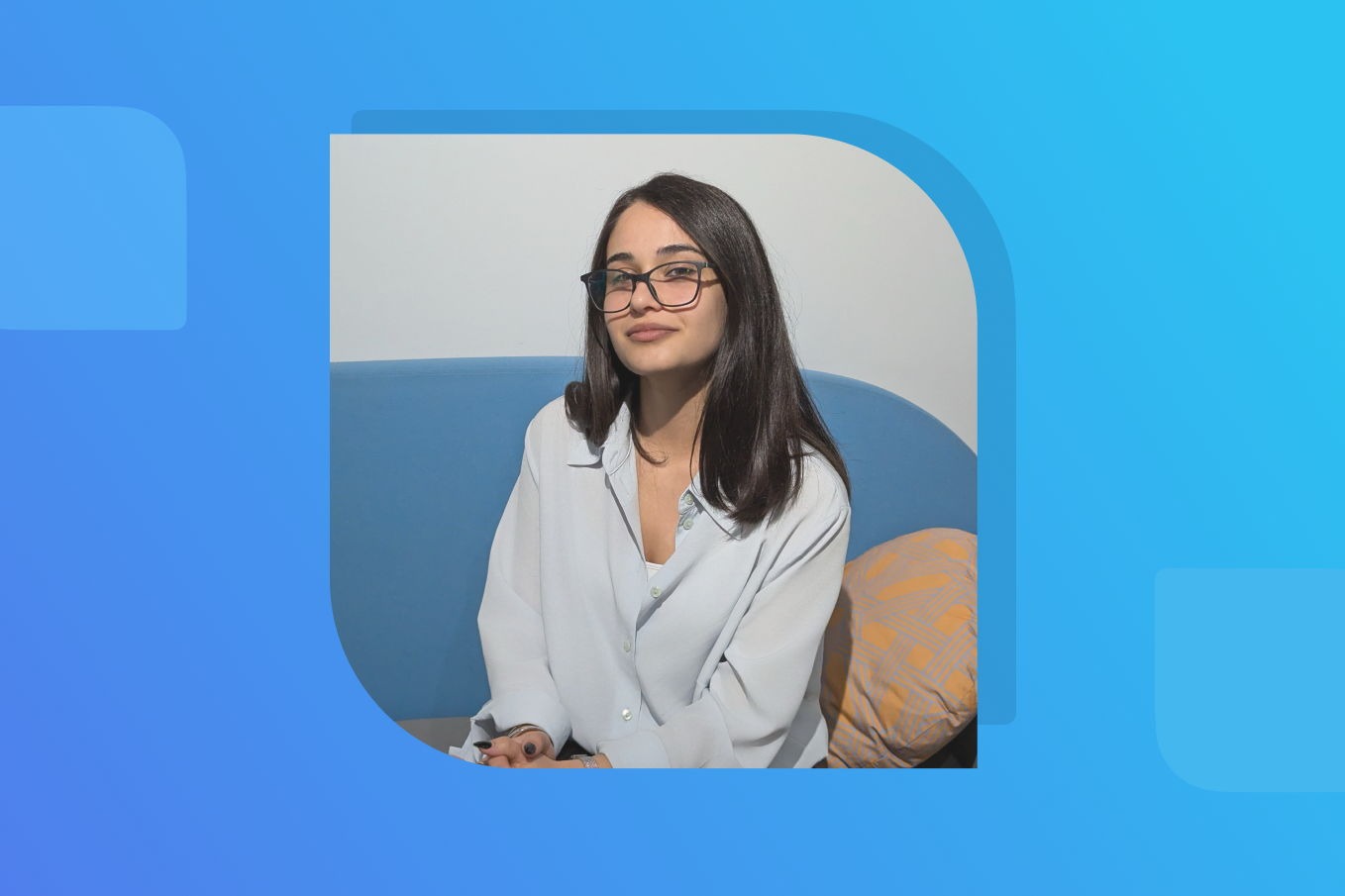


Do you want to switch jobs and find your way in IT, but still need some inspiring examples to make up your mind? Luckily for you, we’ve got three stories of a journalist, a juggler, and a media analyst finding a new job as a project manager, a developer and a designer.
Iryna Bodnar (Lviv)
A journalist-turned-project manager
I studied merchandising, but never happened to work in that field. Instead, during my fourth year I got into journalism and ended up working ten years as a journalist, first in a newspaper and then on TV.
Quite often, I have to explain why I quit such an interesting and creative job. To my mind, journalism is somewhat romanticized. When the word ‘journalism’ pops out, we instantly think about something creative, eventful, and promising. In the beginning, it’s true. But the dream gives way to reality over time. And the reality is a chain of generic tasks requiring less creativity than one can imagine. No surprise, it became depressing.
By that point, I had been looking closely at IT for quite some time. I liked its dynamics: the ever-evolving technologies, business approaches, and changing market demands. In IT, you move with the times. When I initially contemplated changing my profession, IT wasn’t so popular as it is now.
I felt uncertain since I had some achievements as a journalist. I knew that I would have to start my career all over again. By that time, my brother had already switched to IT, and his example was a great inspiration to me. He left his previous job, studied for a year, and attended interviews until he reached his goal and got a job. I started to search for courses because I couldn’t study for so long all by myself, as my brother did. I also consulted with my tester friend who recommended me some books to read.
Before having an interview for a tester position, my brother helped me to boost my technical knowledge, so, I was ready for technical questions. However, when it came down to why I wanted to change my profession, it took me almost fifteen minutes to explain my decision.
I’ve been working it IТ for five years now and I’ve never regretted it. During this time, I’ve grown a lot and become a project manager. But I can easily recall the difficulties that I faced in the beginning of my IT career.
Any advice for IT newcomers?
1. Don’t worry about looking incompetent. That’s the biggest problem. You should accept that by this point, all your previous achievements are irrelevant and now you’re just a junior who has a lot to learn. You might feel stupid after asking five questions. Don’t despair when the fifth question’s asked. Sometimes you need to ask from fifteen to twenty questions to get the idea of basic functionality. Still, it’s okay. No one is a master from the start.
2. Avoid conflicts with yourself. Take a look at what you’re really interested in and choose your area of specialization. Sometimes, people switch to IT just to switch jobs. It’s important to make sure that you’re comfortable in the profession and that it could benefit your self-development.
3. Don’t be afraid. Yes, it’s a difficult path, and you will take some knocks along the way. Most likely, you won’t be employed after the first interview. But this is the invaluable experience that will help you understand where to move next. I admire those who switch to IT in a mature age. Despite having a lot of experience in their previous profession, they’re up for their new place in IT.
Artem Halai (Kiyv)
A juggler-turned-software engineer
I was eight when I found out that one of my acquaintances attended a circus studio. I got enthusiastic about it and joined the studio to study juggling. Later, I decided on entering a circus academy and moved from Kharkiv to Kiev. I worked as a juggler for five years. It was about constant touring, travelling abroad, and working on cruise ships for several months or even half a year.
Eventually, I got a chance of visiting Israel and using a grant for some education programs. Among those available, I chose programming. The training took eight months and included basics of Java, Android, and web development.
I can’t say that studying from scratch was too difficult. We started with computing systems and Java basics. At the same time, I read a lot of subject-related literature. I had no problems with English, a widespread obstacle for those switching to IT, since I used to go on tours where I could practice the language.
Anyway, I still had some difficulties. It was challenging to quickly learn something completely new. There was much information but little understanding. Sometimes, I really needed someone to explain a topic in more details to me.
I chose Android as my specialty, defended my training project, and received a certificate. I had no intention to stay in Israel, so I came back to Ukraine where later I was offered a position of Junior Software Engineer. At the same time, I got my master’s degree in computer science in Kharkiv.
I’ve never regretted changing my profession. I’m still in touch with my circus palls, I have many friends from those times, and I’m interested in their news. But now, juggling is more like a hobby. I keep my juggling balls at home so I can always train a little. Though, now, I don’t have time for a fully-fledged four-hour training.
Any advice for IT newcomers?
1. Don’t worry about having different background. You don’t need to have academic knowledge in math. Now, a lot of information is stored online, and there’s always someone ready to help you. By the way, I’ve just become this someone. One of my acquaintances, a lawyer, has asked me for advice. He’s interested in ІТ, but feels uncertain about having different background and no experience in the sphere. We’ve talked a bit, and I hope that an example of a graduate circus artist and juggler demonstrated him that everything is possible.
2. Don’t give up. There will be difficulties. When studying in Israel, I saw people who quit because of some problems. But the focus on my interests and motivation has really helped me achieve my goal.
Mariia Kuzmenko (Kyiv)
A media analyst-turned-UX designer
Before joining ІТ, I was a political analyst. I worked for the Presidential Administration and other employers. At thirty-four, I quit managerial position to try my hand in a completely new sphere, a decision I’ve never regretted.
It all started with hiring a designer to design some presentations and reports. I was fascinated by her work. There’s no secret that working with politics can be really tiring. That’s why I decided to quit and try something that seemed genuinely interesting to me. I can’t say that the process of switching jobs was fast and easy. It took me two years, after all.
I consulted with my Canadian friend via Skype and signed up for such education platforms as Udemy, Coursera, and Interaction Design Foundation. I liked the Coursera course named Human-Centered Design most (it was around $50 per month). But when studying online, you can never know if you’re moving in the right direction.
In summer 2019, I enrolled on a three-month education program on UX design that I successfully completed. The possibility of combining visual design and user experience was very appealing to me. So, I’ve been working as a UX designer for six months already. Initially, I planned to freelance but soon understood that as a freelancer I could only get a very limited experience. I longed for major research, major budgets, and, therefore, major companies. I’m still haunted by this feeling of transition. I study a lot, ask questions all the time, and acquire new information from other specialists. Sometimes, my work can be difficult since I have projects in various spheres, including finance and real estate. That’s when my experience in analytics comes in handy. I dive deep into details, and the more I learn, the easier it is to make decisions.
Any advice for IT newcomers?
1. Consult with someone who provides career counseling. Make sure you choose rationally, not emotionally.
2. Move on! Despite stress, doubts, and workload, make sure that you do what you want to do. This mindset changes the attitude to work and clarifies what steps you should make to advance. For example, I’m going to continue my studies soon.
3. Study offline. This is a perfect way to get mentoring support and feedback and expand your professional network. Having personal connections with specialists in your sphere is really very important.